Toilet and MSGs
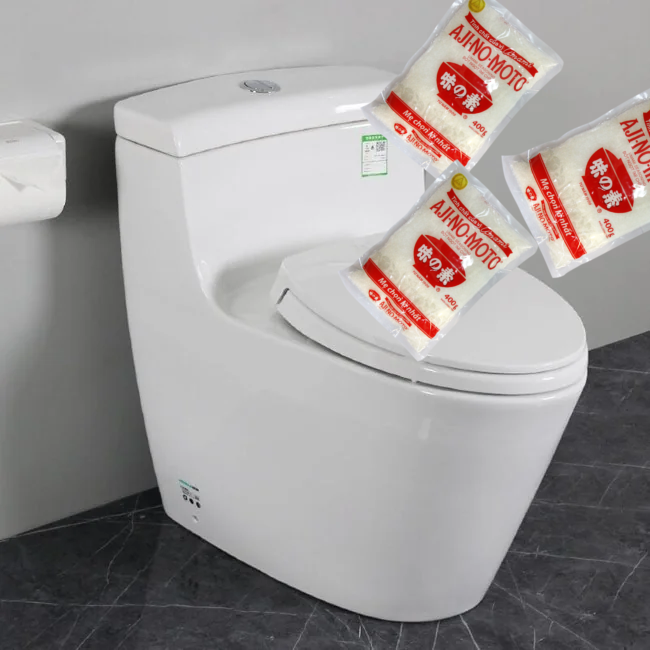
The secret to the world's most advanced artificial intelligence, the ultra-fast smartphone in your pocket, and the global computing grid isn't locked away in a top-secret Silicon Valley lab.
It's sitting right in your kitchen pantry. Specifically, it's MSG.
If you love ramen, fried rice, or practically any savory snack, you already know Ajinomoto. Founded over a century ago in Japan, they are the legendary food brand that literally invented and commercialized Monosodium Glutamate (MSG). But what Apple, Nvidia, and Intel don't like to brag about in their flashy, trillion-dollar keynotes is that their entire existence currently hinges on this exact same soup seasoning company.
If Ajinomoto stopped doing what they do tomorrow, the global production of iPhones, graphics cards, and AI supercomputers wouldn't just slow down—it would grind to an absolute, catastrophic halt.
And as if that wasn't weird enough, the other silent master holding the semiconductor supply chain together? A company famous for making toilets.
Here is the bizarre, highly-classified-feeling reality of how Ajinomoto and Toto secretly run the tech world.
The MSG Monopoly: Ajinomoto Build-up Film (ABF)
How exactly did a food company become the undisputed backbone of modern computing?
Back in the 1990s, the tech industry hit a massive physical wall. As computer chips shrank and became more powerful, engineers had to figure out how to wire microscopic, nanometer-sized transistors on a piece of silicon to the millimeter-sized pins on a motherboard. To do this, they needed a highly specialized insulating substrate—a film that wouldn't warp under extreme heat, wouldn't conduct electricity, and could be applied as a flawless, microscopic layer.
Traditional liquid insulators were messy and completely failing. The entire tech world was stuck. Enter Ajinomoto.
A researcher at the food company realized that the exact same amino acid chemistry they had been studying for flavor additives could be tweaked to create an incredibly durable, heat-resistant epoxy resin. They created a film that could be pressed perfectly onto chips.
It was named Ajinomoto Build-up Film (ABF).
Today, it is a staggering global monopoly. Every single high-performance processor on the planet, from the Snapdragon chip in your Android to the $40,000 Nvidia GPUs powering ChatGPT is layered with ABF. In fact, during the massive global chip shortage of 2020 and 2021, the biggest bottleneck wasn't just silicon, it was an "ABF shortage."
The biggest, most powerful tech giants in the world literally had to sit on their hands and wait for a food seasoning company to scale up its resin production before they could build more PlayStations, graphics cards, and cars.
The Bidet Breakthrough: Toto's Electrostatic Chucks
While Ajinomoto holds the final chips together, the actual manufacturing of the raw silicon itself relies on another incredibly unlikely hero: Toto, the Japanese brand legendary for its luxury heated toilets and self-cleaning bidets.
To build a modern 3nm or 5nm chip, semiconductor foundries like TSMC have to blast silicon wafers with plasma and extreme ultraviolet light inside cryogenic vacuum chambers. This process requires unfathomable, atomic-level precision.
But here's the problem: how do you hold a delicate silicon wafer perfectly still while you blast it with lasers? You can't use metal clamps since they apply uneven pressure, warp the silicon, and introduce microscopic metal dust that would instantly ruin a multi-million-dollar batch of chips.
The solution? You grip the wafer using static electricity. And to do that, you need a highly specialized, ultra-pure ceramic plate called an electrostatic chuck.
It turns out that the exact same advanced materials science required to make an indestructible, hyper-smooth, stain-resistant smart toilet is the perfect foundation for high-end industrial ceramics. Toto had been perfecting fine ceramics for decades. They realized they could manufacture these electrostatic chucks better, flatter, and purer than almost anyone else in the world.
Today, Toto's ceramics division is a quiet, dominant powerhouse in the semiconductor space. Without their impeccably engineered ceramic plates holding the silicon wafers steady, the cutting-edge lithography machines used to print the world's most advanced chips simply cannot function.
The Humbling Reality of Big Tech
In a world obsessed with AI valuations, dumb fuck tweets from Elon Musk about how he can build an advanced foundry, and people who worship CEOs like their life depended on it, it's incredibly humbling to look at how the sausage is actually made.
We love to treat tech giants as invincible innovators who conjure the future out of thin air. Fanboys will go to war in the comment sections defending their favorite smartphone brand's engineering prowess. But the reality of hardware is far messier, weirder, and more deeply interconnected than any tech company will ever admit.
So, the next time you use ChatGPT to write an email, marvel at the ray-tracing graphics on your new gaming PC, or snap a 8K video on your phone, give a little respect to the unsung heroes of the digital age. Your entire digital life is being held together by the makers of your toilet and your ramen.